EU to launch counter-tariffs against US on Friday
The European Union will launch a raft of retaliatory tariffs against US exports on Friday, a top official has said.
The move comes after US President Donald Trump imposed steep duties on steel and aluminium earlier this month.
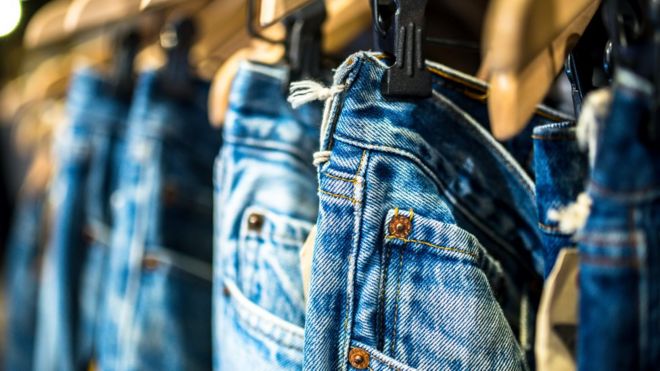
American exports such as blue jeans, motorbikes and bourbon whiskey will be targeted, trade commissioner Cecilia Malmstrom confirmed.
However, she said the bloc "did not want to be in this position".
"The unilateral and unjustified decision of the US to impose steel and aluminium tariffs on the EU means that we are left with no other choice," she said.
- Trump threatens more tariffs on China
- US imposes metal tariffs on key allies
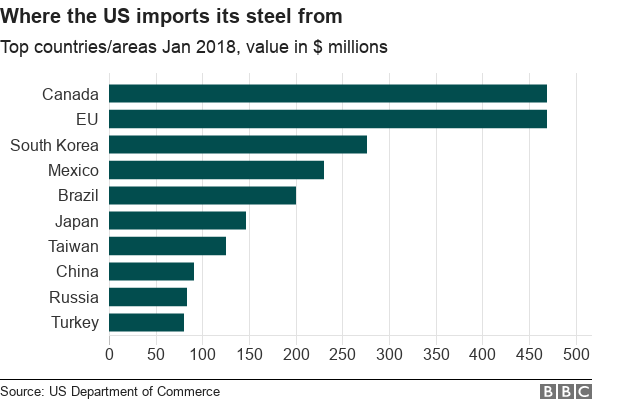
Brussels drew up the list of products in March when Mr Trump initially proposed the 25% tariffs on steel imports and 10% on aluminium, which also target Canada, Mexico and other close US allies.
Cranberries, orange juice, sweetcorn and peanut butter are among the other goods targeted.
It comes amid an intensifying row over trade between the US and its partners.
On Tuesday, Mr Trump threatened to impose duties on an additional $200bn (£151bn) of Chinese goods after hitting $50bn of products with tariffs.
He said the 10% duties would come into effect if China "refuses to change its practices".
However, China accused the US of "blackmail" and said it would "fight back firmly", raising fears of a full-blown trade war.
How did this start?
Mr Trump announced plans for tariffs on foreign steel and aluminium in March, justifying them on national security grounds.
He has argued that global oversupply of steel and aluminium, driven by China, threatens American steel and aluminium producers, which are vital to the US.
- What is a trade war and why should I worry?
- IMF sounds alarm on US trade tariffs
Since the announcement, South Korea, Argentina, Australia and Brazil have agreed to put limits on the volume of metals they can ship to the US in lieu of tariffs.
However, Canada has announced it will impose retaliatory tariffs on C$16.6bn (£9.5bn) worth of US exports from 1 July.
And Mexico put tariffs on $3bn worth of American products ranging from steel to pork and bourbon two weeks ago.
The measures have also prompted complaints at the World Trade Organisation, including from India and Norway.
 REUTERS
What does the EU say?
Ms Malmstrom called the EU response proportionate and in line with World Trade Organization rules.
She said that counter-measures - which affect €2.8bn worth of US goods - would be removed if Washington removed its metal tariffs.
EU steel and aluminium exports now facing US tariffs are worth a total of €6.4bn (£5.6bn).
What could the impact be?
Many of the products the EU has in its sights are specifically chosen to have maximum political effect. Bourbon whiskey is produced in Kentucky, the state of Senate majority leader Mitch McConnell.
Orange juice is a key export for Florida, a swing state in the US elections.
Meanwhile, economists have warned the US metal tariffs could lead to higher metal costs, disrupt supply chains and even get passed on to US households.
Last week, the International Monetary Fund warned that the Trump administration's protectionist policies are likely to hurt the US economy and undermine the world's trade system.
IMF director Christine Lagarde said a trade war would lead to "losers on both sides" and have a "serious" impact.
US Commerce Secretary Wilbur Ross has dismissed the concerns about higher costs, arguing that the effects would be minimal.
At a hearing in Washington on Wednesday, he blamed a spike in the price of steel on speculative activity and said his department would conduct an investigation into "illegitimate profiteering".
And in March, Mr Trump signalled he could impose yet more retaliation if the EU raised trade barriers on US companies.
What is the reaction in the US?
US politicians criticised the measures at a hearing in Washington on Wednesday, saying they were hurting American businesses and alienating allies.
US Senator Pat Toomey, a Republican from Pennsylvania, said the use of national security to justify the metals tariffs was "wholly inappropriate".
He is co-sponsor of a bill that would limit the administration's authority on trade.
Lawmakers also said the administration's process for granting companies exemptions from the tariffs is in disarray.
Companies have submitted more than 20,000 requests for exemptions from the measures, Mr Ross said.
He said the department has granted 42 exemptions from the steel tariffs and denied 56.
Senator Claire McCaskill, a Democrat from Missouri, said the US should have published a list of exempted products when the tariffs were announced.
She said the administration was handling the issue in a "chaotic and frankly incompetent manner".
Comments
Post a Comment